
Round-table discussion: ‘ETS as a source of public revenue’
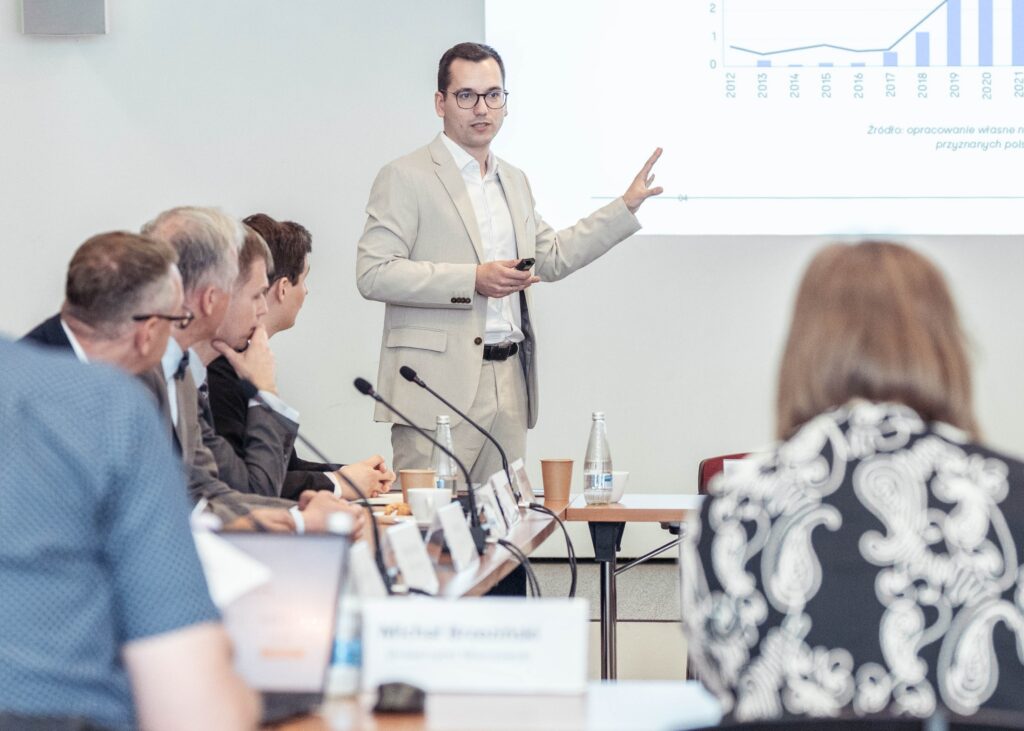
The role of European Union Emissions Trading System (EU ETS) revenue in public finances and the direction of its further reform were the main topics of a round-table discussion organised in Warsaw by the Reform Institute and Insight Policy. The discussion, held on 23 June 2026, was attended by representatives of the public administration, the business community, non-governmental organisations, the financial sector, the trade press and the academic community.
The discussion began with a presentation of the key findings from the Reform Institute’s new report ‘Overt Costs, Hidden Benefits: The Financial Balance Sheet of Poland’s Participation in the EU ETS’.
Summary of the discussion:
Challenges and analysis
- The EU ETS remains one of the key instruments for implementing the European Union’s climate policy, and its continued operation is a crucial factor in driving the energy and industrial transition.
- The reform of the EU ETS presents an opportunity to strengthen the instruments supporting the transition and to increase the benefits for Member States actively participating in the negotiation process.
- Polish industry faces the challenge of rising costs for purchasing allowances under the EU ETS and a reduction in the number of free allowances allocated. This is linked to the challenge of maintaining competitiveness within the EU and globally.
- Let us not forget how much has been achieved in Poland in recent decades in terms of the transformation of the energy sector and industry. There are examples worth building on.
- A key challenge remains to increase the pace and efficiency of utilising available EU funds – the Modernisation Fund and the Innovation Fund – and to better tailor financial instruments to the needs of beneficiaries.
- Revenues from the ETS have so far been too invisible to the public and the business community. They have also too often been spent primarily in response to current, short-term needs. Although Poland’s reports on the spending of their financial equivalents have never been questioned by the European Commission.
- There is a lack of broader discussion on the desired directions for spending these billions of zlotys in a fair and effective manner. Funds from the EU ETS require more strategic planning and transparent spending, based on clearly defined investment priorities and a long-term vision for the transition.
- The proposal to return to the idea of an Energy Transition Fund is currently politically difficult to push through. This is particularly due to the limited fiscal space in the state budget and the need for flexibility in the spending of public funds. It should also be borne in mind that the value of revenue from ETS auctions fluctuates significantly over the years and, looking further ahead to the late 2030s, will be much lower, which complicates planning.
Recommendations and key conclusions
- It is very important for Poland to participate actively in negotiations on reforming the system, so that it takes account of national economic conditions and maximises the available benefits of participation in the EU ETS.
- It is crucial to make full use of the potential of available EU funds and to ensure appropriate conditions for financing the transition – in particular, maintaining the Modernisation Fund beyond 2030.
- The effective use of EU ETS funds requires greater transparency, visibility and predictability, as well as linking funding to long-term climate and industrial policy objectives. It is not necessary to establish an Energy Transition Fund to achieve this objective. It is worth reviewing the range of interventions funded by the ETS in terms of their effectiveness, in order to increase the predictability and efficiency of investments.
- An important element of the use of EU ETS revenues should be to mitigate the negative social impacts of the transition through appropriately designed support mechanisms for the most vulnerable groups. This is an investment in the social acceptability of the transition.
- Funding should support both the modernisation and decarbonisation of industry and the maintenance of the economy’s competitiveness, taking into account the diverse needs of individual sectors. The priority remains the creation of mechanisms to support investment in the transition whilst minimising social and economic costs.
The introductory presentation by the Reform Institute is available below.


documents

Call for thorough consultations on the NECP update

Business calls on the government to act – the ‘Pact for Polish Industry’ has been submitted to Minister Domański

Participation of Reform Institute in public consultation on revision of the National Recovery Plan (NRP)

Appeal regarding the new Multiannual Financial Framework

Third National RoundBaltic Roundtable in Poland

Document worth 11 billion euros. Reform Institute evaluates draft Social Climate Plan.

We cannot waste the opportunity to unlock the potential of green electrification: call to action for PEP2040 and NECP update

Open letter from 25 organisations to Energy Minister Miłosz Motyka regarding the acceleration of work on NECP
Call for an ambitious National Energy and Climate Plan

The Reform Institute assesses the NECP: An ambitious scenario without financial and sectoral decisions will remain a vision on paper

Call to the Ministry of Climate and Environment to create the space for constructive dialogue around the NECP update

Supporting the Polish-Dutch cooperation in the offshore wind energy sector


Zapisz się
do newslettera