
Appeal regarding the new Multiannual Financial Framework

The Institute for Reforms, together with the Lewiatan Confederation, has written to Andrzej Domański, Minister of Finance and the Economy, and Katarzyna Pełczyńska-Nałęcz, Minister of Funds and Regional Policy, in connection with the ongoing negotiations on the European Union’s budget for the next seven years. In their letter, the organisations call for increased funding for the transition within the Multiannual Financial Framework. They also emphasise the importance of the Partnership Plan, which the government will be preparing as part of this process. The document should serve to bring about a profound modernisation of the economy, rather than being a source of further short-term safety-net programmes and political compromises.
Mr Andrzej Domański
Minister for Finance and the Economy
Ms Katarzyna Pełczyńska-Nałęcz
Minister for Funds and Regional Policy
The competitiveness of the Polish economy is currently being decided in the dispute over the new EU budget
Poland needs secure and affordable energy from renewable sources. That is why the new European Union budget must accelerate the modernisation of the economy.
For Polish households and businesses, the energy crisis is not an abstract political debate. It is a harsh reality evident in rising electricity bills and production costs, which threaten the viability of businesses across many sectors of the economy – from the chemical industry to food processing plants. Recent years have painfully demonstrated that dependence on imported fossil fuels is not only an economic problem but also a serious strategic weakness.
Following Russia’s aggression against Ukraine and its use of energy resources as a tool of pressure, the energy transition has become a matter of economic and social security. Every modernised electricity grid, every insulated building and every new domestic energy source – from wind farms in the Baltic Sea to nuclear power stations – increases Poland’s resilience to external shocks.
However, to achieve this independence, Poland must tackle a key financial challenge that cannot be resolved at the national level alone. The European Union is currently negotiating a new Multiannual Financial Framework – a seven-year budget that will set the direction for European spending after 2028. The pace of modernisation, industrial transformation and economic resilience of both Poland and Europe as a whole will depend on the shape of this framework.
Who will pay for our future?
Europe’s energy ambitions are increasingly coming up against fiscal constraints. The size of the future EU budget remains the main point of contention in Brussels.
Poland urgently needs large-scale investment in modern electricity grids, energy storage facilities, biomethane, a support scheme for low-carbon fuels and the RFNBO, as well as the associated infrastructure and the infrastructure enabling the electrification of industry, buildings and transport. Stable and affordable electricity is no longer a luxury. It is becoming the cornerstone of the economy’s competitiveness and a prerequisite for maintaining Poland’s industrial presence in the global market.
Relying solely on national budgets to fund the transition risks creating a dangerous two-speed Europe.
Without a strong pan-European support framework, there is a risk that wealthier countries will transition more quickly, whilst countries still catching up in terms of development, such as Poland, will face greater cost and competitive pressures. This poses a threat to the entire Union. In an integrated single market, persistent differences in energy costs and industrial resilience weaken everyone. That is why joint European funding is now a necessity. Without it, Poland and Europe risk infrastructure delays, a widening investment gap and a loss of competitiveness vis-à-vis those non-EU countries which are already allocating vast amounts of public funds to the development of clean technologies, modern industry and strategic supply chains.
At a time when rising defence spending is beginning to crowd out investment in the energy and industrial transitions, Europe must avoid sacrificing long-term economic strength for the sake of short-term security needs. Without a strong economy, there can be no strong defence. Therefore, the only pragmatic solution is to increase the EU budget and maintain investment in both security and clean technologies, which will determine Europe’s future position.
The crisis requires sustainable investment, not temporary subsidies
The scale of funding alone is only half the challenge. Equally important will be the decisions taken in Warsaw – regarding which reforms Poland will implement and how it will allocate European funds. As part of the negotiations on the new budget, the Polish government will have to prepare a National and Regional Partnership Plan. In practice, as funding from the National Reconstruction Plan (NRP) comes to an end, this will become the most important document outlining the state’s economic strategy for the next decade.
It is this Plan that will determine whether Poland seizes the current opportunity to build a more resilient and competitive economy, capable of functioning under conditions of growing geopolitical and cost pressures. Investing in outdated technologies and maintaining a high level of dependence on imported raw materials would mean further entrenching the structural challenges that are already weakening European industry and increasing vulnerability to future crises.
A proposal for Brussels and Warsaw
On 18–19 June, the budget debate will enter a decisive phase. The European Council will, for the first time, discuss the preliminary draft of the new budget – a document that will set the strategic direction for Europe’s development in the coming years.
This summit will not merely be another technical discussion. It will be a test of whether European leaders have the political will to mobilise the resources needed to build a competitive and resilient economy. Poland is already leading a coalition of 17 ‘Friends of Cohesion’ countries, calling for a larger and more ambitious budget. This group remains in clear disagreement with net contributor countries – such as Germany and Sweden – which are pushing for spending cuts.
Equally important, however, will be whether Warsaw treats the new EU budget and designs the Partnership Plan as a catalyst for the in-depth modernisation of the economy, rather than merely as a source of further short-term support schemes and political compromises. At stake is Poland’s future position in an increasingly competitive international environment. Strategic investments can safeguard the domestic industrial base, attract new production capacity and enable Poland to build competitive advantages in clean technology sectors. Wasting this opportunity risks leaving the country lagging behind nations that are investing more rapidly in modern infrastructure and technologies.
The cost of delays is already evident in energy bills. However, the cost of further inaction will be far greater: a weaker economy, capital outflow and growing dependence on decisions taken outside Poland.
Poland must seize this opportunity to secure the future of its industry and economy for decades to come.
Marek Górski
President of the Lewiatan Confederation
Zofia Wetmańska
Vice-President of the Institute for Reforms


Participation of Reform Institute in public consultation on revision of the National Recovery Plan (NRP)

Open letter from 25 organisations to Energy Minister Miłosz Motyka regarding the acceleration of work on NECP
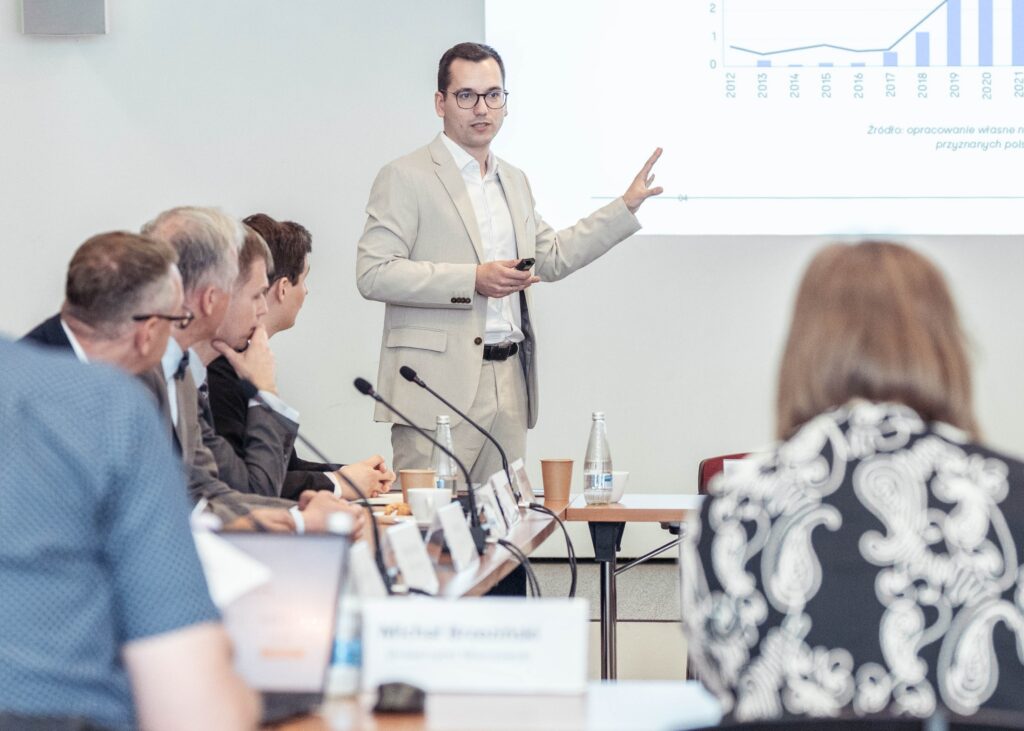
Round-table discussion: ‘ETS as a source of public revenue’

The Reform Institute assesses the NECP: An ambitious scenario without financial and sectoral decisions will remain a vision on paper

Business calls on the government to act – the ‘Pact for Polish Industry’ has been submitted to Minister Domański

Call for thorough consultations on the NECP update

Third National RoundBaltic Roundtable in Poland

Document worth 11 billion euros. Reform Institute evaluates draft Social Climate Plan.

We cannot waste the opportunity to unlock the potential of green electrification: call to action for PEP2040 and NECP update
Call for an ambitious National Energy and Climate Plan

Supporting the Polish-Dutch cooperation in the offshore wind energy sector

Call to the Ministry of Climate and Environment to create the space for constructive dialogue around the NECP update


Zapisz się
do newslettera