
Towards a fair reform of the EU ETS: What is Poland’s interest in European negotiations?

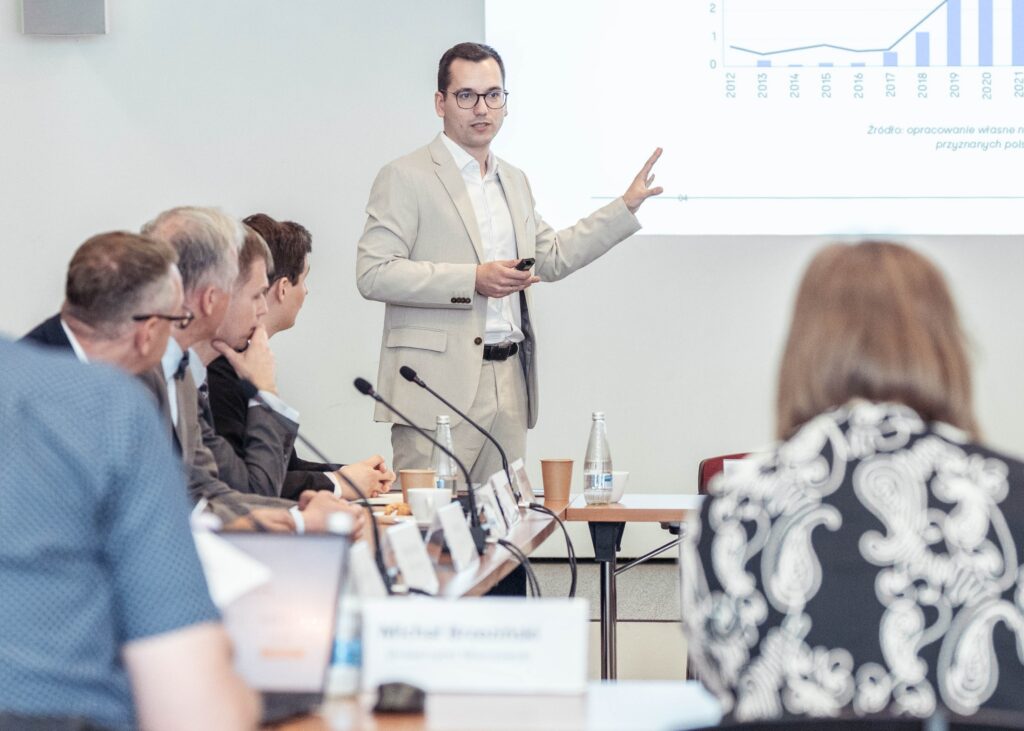
“Towards a fair reform of the EU ETS: What is Poland’s interest in European negotiations?” was another in a series of meetings organised by the Reform Institute on the EU ETS. The event took place on 3 September 2026 and brought together representatives of public administration, think tanks, business, academia and non-governmental organisations.
The discussion focused on the proposed changes to the EU ETS presented by the European Commission in July this year, as well as calls for further amendments as part of the ongoing negotiations at EU level. The starting point for the discussion was a presentation of the key findings of the Reform Institute’s latest publication.
Strengthening funding mechanisms that provide Poland with stable financing
Participants agreed that it is in Poland’s interest to strengthen revenue streams that are allocated directly to Poland and Polish entities without competitive conditions. The Modernisation Fund, of which Poland is the largest beneficiary, was highlighted in particular. Some participants argued that competitive funding schemes do not adequately reflect the readiness of Polish industry to compete for these resources.
It was noted that the proposed first come, first served approach under the ETS Investment Booster favours countries with investment-ready innovative projects, structurally disadvantaging those still developing their decarbonisation capacity. For Poland, strengthening the Modernisation Fund should be a higher priority, potentially alongside the establishment of national funding envelopes under the Industrial Decarbonisation Bank, rather than requiring Poland to compete for these resources with other countries, including countries within the lower-income group to which Poland belongs.
At the same time, other participants emphasised that the EU ETS should not be treated solely as an emissions reduction tool, but also as an instrument of industrial transformation. From this perspective, all funding mechanisms – modernisation, competitive and innovation funds – play complementary roles.
Allocating 30% of ETS revenues to EU own resources: unequivocal opposition
Participants representing public administration and public institutions strongly opposed the proposal to redirect 30% of ETS auction revenues to the EU’s own resources. They stressed that this is a separate negotiating issue under the Multiannual Financial Framework for 2028 onwards, requiring unanimity in the Council and ratification by national parliaments—an outcome considered unlikely in practice.
Implementing the proposal in its current form would mean that the funds would not constitute an “additional pool” of resources for climate objectives, but would instead be shifted from one funding envelope to another, while reducing national discretion over how the revenues are spent.
The solidarity pool and the Modernisation Fund: mixed assessments
The proposal to make the allocation of the solidarity pool to the Modernisation Fund mandatory from 2031 onwards received a mixed response. Some participants highlighted a structural asymmetry in the proposal: countries benefiting from the Modernisation Fund, including Poland, would lose control over the solidarity pool, while countries such as Spain—which also receive a share of the 10% solidarity redistribution—would retain full control over how those funds are used.
Other participants supported the proposal, arguing that these resources should in any case support the transition and that the proposed change would provide a practical means of enforcing this requirement.
Conditionality of free allocation: one of the most contested elements of the reform
Participants noted that making free allocation conditional could have negative consequences, particularly given the uncertainty surrounding the effectiveness of the Carbon Border Adjustment Mechanism (CBAM) in preventing carbon leakage—the relocation of emissions-intensive production outside the European Union. It was argued that free allowances should be treated as a mechanism for protecting industrial competitiveness, rather than as a tool for providing conditional support.
Others, however, argued that some degree of conditionality was necessary, albeit at a lower level than the currently proposed 20%, depending on the technological readiness of individual sectors. Requiring decarbonisation plans from installations receiving free allowances was also considered valuable as a means of enabling public authorities to collect and analyse information about these sectors, even if the conditionality mechanism itself were made less stringent.
Supporting Polish companies in EU funding competitions
Although Polish businesses make extensive use of the Modernisation Fund, they do not take sufficient advantage of other EU-level funding programmes designed to help companies maintain their competitiveness. According to experts, businesses should receive active support in accessing these resources.
Participants also questioned the rationale for supporting large companies with billion-euro budgets: why do these same companies, despite having genuine decarbonisation needs, not actively seek out the EU funding available to them? They highlighted the need to better identify and address the barriers preventing large industrial companies from accessing these funds. The possibility of improving the operation of the Innovation Fund was also raised.
Experts also pointed to the need for greater transparency across the EU ETS and for greater clarity in the complex rules governing the system and its proposed amendments.
Implementation of the WAM scenario depends on EU negotiations
Participants from public administration emphasised that implementing the national WAM (With Additional Measures) scenario under Poland’s National Energy and Climate Plan (NECP) requires adequate financial resources, which in turn depend on the outcome of EU-level negotiations.
The idea of establishing a national Energy Transition Fund, or a similar mechanism providing predictable and transparent support for industry and the energy sector financed through the EU ETS, was considered worth exploring. However, decisions on launching such a mechanism would require coordination across the government as a whole.
Proposal to merge the ETS and CBAM into a single regulatory framework
During the discussion, participants proposed combining the ETS and CBAM into a single regulatory framework. The rationale was that this could slow the introduction of conditionality for free allocation if CBAM proved ineffective. It was also argued that CBAM, in its current form, might not provide sufficient protection for Poland’s energy-intensive sectors.
Issues less prominent in Polish public debate
In addition to the main topics – the Modernisation Fund and the Industrial Decarbonisation Bank, including the ETS Investment Booster – the discussion also covered several issues that receive less attention in Polish public debate:
- A new methodology for calculating compensation for indirect emissions costs (Article 10a(6) in the revised text). Under the proposed approach, calculations would be based on national energy mixes rather than a uniform EU-wide coefficient, with projects also differentiated according to a quality-based geographical approach. For Poland, which has one of the most emissions-intensive energy mixes in the EU, this could potentially result in a significant increase in compensation for energy-intensive sectors.
- No changes to Article 29a of the ETS Directive. The existing mechanism for responding to high prices, designed to function like a “price corridor”, remains unchanged in the proposal, despite never having been activated in practice because its trigger threshold is too high. Participants highlighted the need to turn it into an effective price safeguard.
- Inclusion of new types of instruments in the system, including permanent carbon removals and international carbon credits. This opens up a discussion on how Poland could benefit from the development of this market and how it should be governed at EU level.



Fair and ambitious modernisation of Poland. How to spend billions from ETS2 effectively?
The study on the EU ETS revenue use for social justice and climate neutrality in the context of Social Climate Fund and ETS2
Towards a fair reform of the EU ETS. What is Poland’s interest in the EU negotiations?


Zapisz się
do newslettera