
Towards a fair reform of the EU ETS. What is Poland’s interest in the EU negotiations?

Poland stands to gain as much as PLN 180 billion by 2040 from the changes to the EU ETS proposed by the European Commission. This figure could rise to as much as PLN 240 billion if Reform Institute’s recommendations in the current EU-level negotiations are implemented. Whilst effective diplomacy is important, ambitious modernisation of industry and the energy sector – including efforts to implement the accelerated transition scenario (WAM) from Poland’s National Energy and Climate Plan – will be even more crucial for Poland’s favourable balance within the system, according to a new publication by the Reform Institute – “Towards a fair reform of the EU ETS. What is Poland’s interest in the EU negotiations?”.
Additional billions in exchange for stricter conditions
In mid-July, the European Commission presented proposals for changes to the EU ETS. This marks a pivotal moment in the intense debate, which has been ongoing for months, regarding the system’s impact on the competitiveness of the European economy. Negotiations on the proposed course correction are particularly important for Poland, which faces a significant challenge in achieving a just transition due to the high share of fossil fuel use and the billions flowing into the state budget and Polish companies from the scheme.
According to the latest publication, Poland could gain as much as PLN 180 billion from the Commission’s EU ETS reform proposal as a result of: a slower decline in the number of allowances within the scheme, the extension of the Modernisation Fund (MF) until 2040, the introduction of the Industrial Decarbonisation Bank (IDB) with preferential access for lower-income countries under the ETS Investment Booster, and the extension of the Innovation Fund (IF). If the EC changes are implemented, the Polish government and Polish entities can expect total financial benefits from the EU ETS to exceed PLN 550 billion between 2026 and 2040.
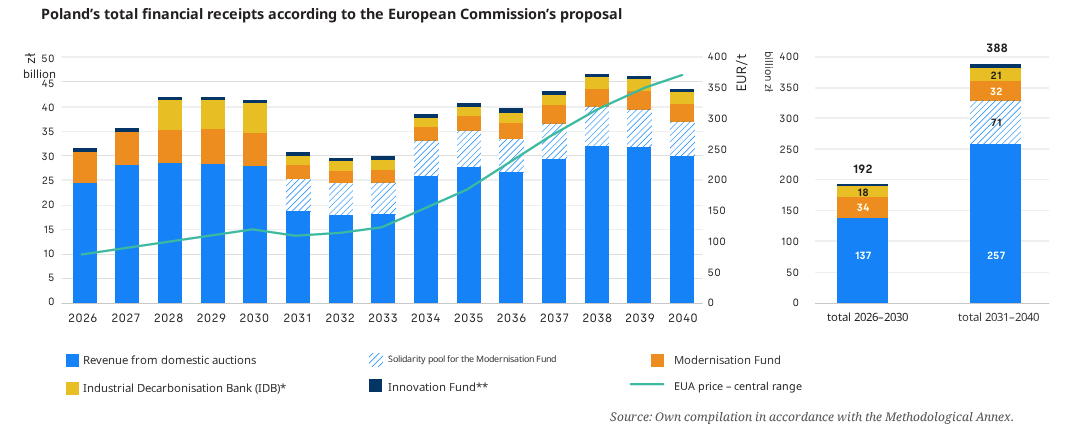
The increase in funding for the transition is to be accompanied by restrictions on the government’s freedom to spend the billions generated by the EU ETS. At least 50 per cent of revenue from national auctions is to be channelled back to sectors covered by the EU ETS, whilst the solidarity mechanism – which until now has been allocated to national auctions and constituted revenue for the state budget – will be directed to the Modernisation Fund, which has more restrictive guidelines.
As Michał Wojtyło, Senior Public Policy Analyst and co-author of the publication, notes:
Increasing the capacity of EU funds financed by the EU ETS, together with greater transparency regarding the spending of EU ETS revenues and the obligation to plan this spending in advance, is intended to ensure a larger and more predictable flow of funds for investments in the modernisation of industry and the energy sector.
National measures even more important than negotiations
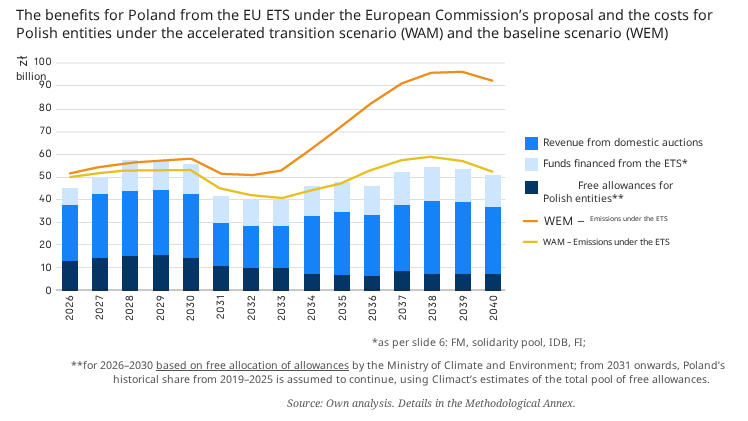
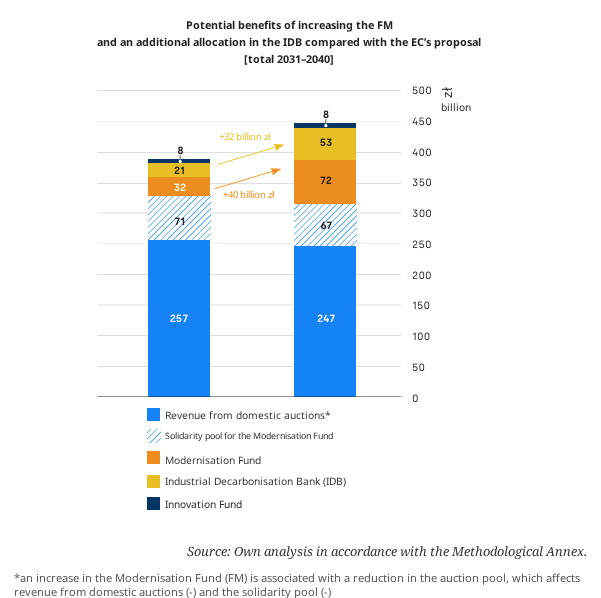
The publication clearly shows that, for Poland’s overall balance in the EU ETS to be close to equilibrium, it is necessary to implement the accelerated transition scenario (WAM) from the Polish National Energy and Climate Plan (NECP). Under the WAM scenario, the cost of purchasing allowances exceeds the financial benefits for Poland by no more than PLN 7 billion per year; however, if the additional increase in the Modernisation Fund (FM) compared to the European Commission’s proposal, or an extension of the allocation for lower-income countries in Phase II of the Industrial Decarbonisation Bank (IDB) is negotiated, Poland’s annual financial benefits may exceed the costs of purchasing allowances.
The pace of the transition within the country is even more significant for the balance of Poland’s participation in the EU ETS than the outcome of the negotiations in Brussels. Striving to implement the WAM scenario of the NECP should be one of the main objectives of the Polish government, not only in the context of the sustainable and just modernisation of the Polish economy, but also in terms of reducing the costs of the EU ETS for the economy. The total costs of purchasing allowances in the EU ETS up to 2040 could be as much asPLN 270 billion lower for Polish entities than in the reference scenario (WEM) of the NECP, equalling the total financial benefits from the system -emphasises Aleksander Śniegocki, President of the Reform Institute.
The Reform Institute, in its new publication, also proposes the following at national level:
- A more transparent and strategic use of EU ETS revenues, and cross-cutting support for households using EU ETS funds,
- A clearer national framework for industrial transition, including the removal of legal barriers, the streamlining of procedures, and investment in shared infrastructure (electricity, hydrogen, CO₂),
- Combining EU ETS revenues with national instruments to secure greater funding from EU competitive funds (e.g. support in preparing applications, an ‘auction-as-a-service’ mechanism, a pilot scheme for the Carbon Contract for Difference (CCfD)).
Poland’s interests in further negotiations
This is not the end of possible changes to the EU ETS. The coming autumn is a crucial time for the Polish government to negotiate a fair reform of the EU ETS.
Poland could gain as much as an additional PLN 58 billion compared with the European Commission’s proposal as a result of extending the allocation for lower-income countries under Phase II of the Industrial Decarbonisation Bank (similarly to the ETS Investment Booster) and by maintaining the Modernisation Fund’s allocation at 4.5 per cent of the allowance pool after 2030, i.e. at the current level – estimates Paulina Masternak, co-author of the publication and Public Policy Analyst at the Reform Institute.
Among other recommendations at EU level arising from the analysis ‘Towards a fair reform of the EU ETS. What is Poland’s interest in EU negotiations?’ is a proposal to change the method of allocating free allowances to a two-track approach – taking into account the need both to stimulate investment and to maintain basic support during the transition period for the industry. Another recommendation is to seek the rejection of the proposal to transfer 30% of EU ETS revenues to the EU’s own resources under the new Multiannual Financial Framework, which could ultimately lead to reduced funding for climate and energy.










Zapisz się
do newslettera