
National Building Renovation Plans at the finish line: are we ready for 2030, 2040 and 2050? Insights from Poland and Germany
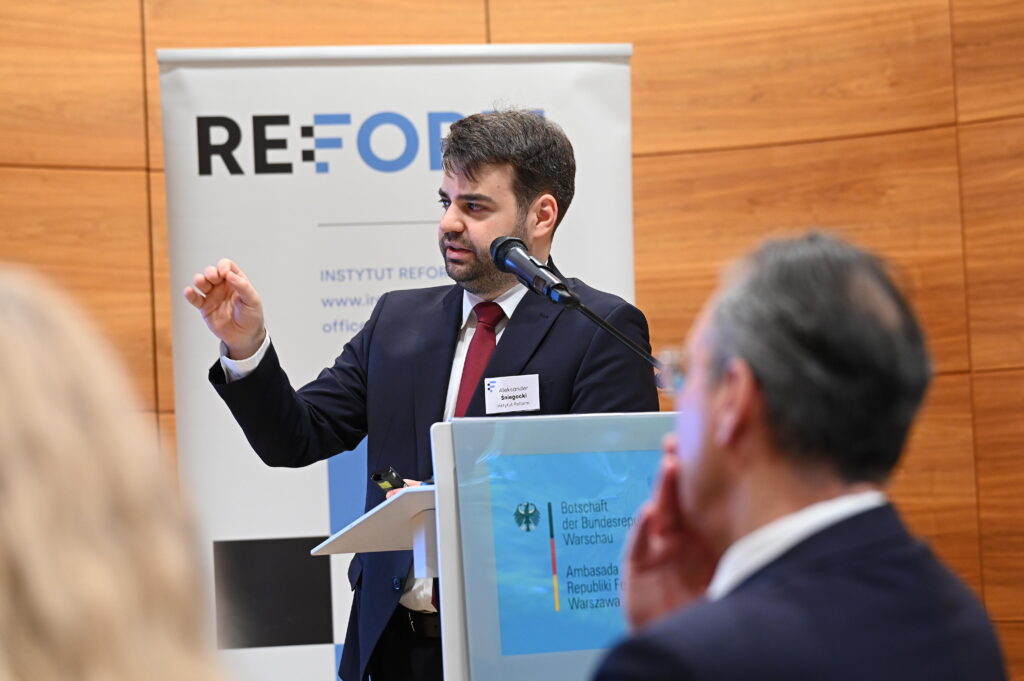
On 20 October 2026, the Reform Institute held a conference at the Embassy of the Federal Republic of Germany in Warsaw, organised in cooperation with the Embassy. The meeting brought together Polish and German experiences in finalising the National Building Renovation Plans (NBRPs), which EU Member States must submit to the European Commission in their final form by 31 December 2026.
The conference was attended by 50 participants, including representatives of public administration, energy agencies, companies and industry associations, and think tanks. They discussed whether the plans under preparation and the accompanying regulations will make it possible to meet the EPBD targets for 2030, 2040 and 2050, and what the two countries can learn from each other.
Poland and Germany at different stages
Both the Polish and the German draft NBRP are consistent with the key objectives of the EPBD, but the two countries are at different stages. Germany submitted its draft plan in May 2026 and received the Commission’s comments in July. Poland published an early draft for pre-consultation in December 2024 but has not yet submitted it to the European Commission. Poland has already received a second warning from the Commission over the delay, and the publication date of the new version of the plan remains unknown.
Poland’s investment needs are higher relative to GDP (1.6% compared with 1.0% in Germany), and the country relies more heavily on public funds (35% compared with 25%). According to Reform Institute calculations, the 2050 target in practice means deep renovation of the entire existing building stock, which works out at a baseline of around 4% of buildings per year. In Germany, the renovation rate is around 3.4–3.5% of building floor area per year, but light renovations, which deliver primary energy savings of 3–30%, make up most of it.
Germany transposed the EPBD through the Building Modernisation Act (GModG) using a “1:1” approach. In doing so, it dropped the requirement for 65% renewable energy in new heating systems in favour of technology neutrality. The German draft NBRP covers all the mandatory categories, but much of the data is missing, including an EPBD-compliant methodology for calculating the renovation rate and energy poverty indicators. Germany has also not yet set up a national database on the energy performance of buildings, renovation passports or one-stop shops.
Building data and energy performance classes
The Polish register holds almost 3.4 million energy performance certificates (EPCs), but only around 527,000 of them cover whole buildings (data as of the end of 2024). The open data portal does not include information such as building type, floor area or year of construction. Because Poland has no energy performance classes in force yet, it can design them from the start in line with the EPBD.
On the German side, there is a lack of good-quality information on existing non-residential buildings. The available data make it possible to estimate the scale of the problem but not to identify the specific worst-performing buildings. Data on the life-cycle carbon footprint of buildings were seen as the hardest to obtain.
A new indicator: total primary energy
The revised EPBD introduces total primary energy, the sum of renewable and non-renewable energy, as the new binding indicator of a building’s energy performance. Until now, EPCs have been based solely on non-renewable primary energy demand (EP). The change requires a lot of work across the whole regulatory system, and the EP values from existing certificates will have to be recalculated. In Germany, certificates issued from 2027 will already be based on total primary energy.
Financing renovation
Investment needs in Poland are estimated at around PLN 2 trillion by 2050, of which around 35% is expected to come from public support. Participants criticised the lack of continuity in support programmes, the absence of an assessment of the effects of the thermal modernisation tax relief, and subsidy rates of 85–100%, which have inflated market expectations. They noted that funding projects at 50% instead of 100% would allow twice as many projects to be financed. Industry representatives stressed that Polish companies are ready for a much faster pace of renovation, but expect the plan to be published, financing to be predictable and a single coordinator for the process.
Good practices and cooperation
Speakers presented the German EnergieSprong model for serial renovation, the building resources passport (Gebäuderessourcenpass) piloted since 2023, and KAPE’s experience from the iBRoad2EPC project (48 experts, 57 buildings, 6 countries). The Polish-German Energy Platform, run by dena and KAPE, was presented as an example of cooperation between the two countries.
Recommendations
Participants pointed, among other things, to the need to:
- submit Poland’s draft NBRP to the European Commission without delay,
- appoint a government plenipotentiary for building transformation or, as a first step, set up an inter-ministerial working group and a permanent platform for dialogue with the market,
- introduce energy performance classes based on total primary energy and gradually build up a national database,
- designate an operator for the renovation passport system and ensure independent quality control and funding for advisory services,
- provide multi-annual, predictable budgets for support programmes, complemented by loans and guarantees that mobilise private capital,
- communicate the benefits of renovation and counter disinformation about the EPBD.
The meeting showed that renovation is worth treating as an investment that brings long-term benefits, such as lower heating costs and less dependence on fuel imports, and not merely as a legal obligation.
Speakers:
- H.E. Miguel Berger, Ambassador of the Federal Republic of Germany to the Republic of Poland
- Aleksander Śniegocki, President of the Management Board, Reform Institute
- Jerzy Kwiatkowski, Member of the Management Board, Head of Energy Analyses and BREEAM Certification, Polish National Energy Conservation Agency (NAPE)
- Piotr Zdanowski, Energy Efficiency Specialist, Polish National Energy Conservation Agency (KAPE)
- Dr.-Ing. José Mercado, Senior Expert for Circular Construction and Renovation, German Energy Agency (dena)
- Jan Ruszkowski, Managing Director, Renovation Wave Association (Fala Renowacji)
- Dr Kjell Bettgenhäuser, Director – Communities, Energy & Infrastructure, Guidehouse Germany
- Anna Tomaszczyk, Deputy Head of the Economic Department, Embassy of the Federal Republic of Germany in Warsaw


Effective instruments supporting comprehensive energy modernisation of buildings in Poland

Poland’s renovation wave: the benefits of building modernisation

Unpacking REPower EU: what does the plan mean for the building sector?

“To overcome energy and transport poverty” – Reform Institute report


Zapisz się
do newslettera