
A strategy without a plan. Poland needs a path to development, not declarations
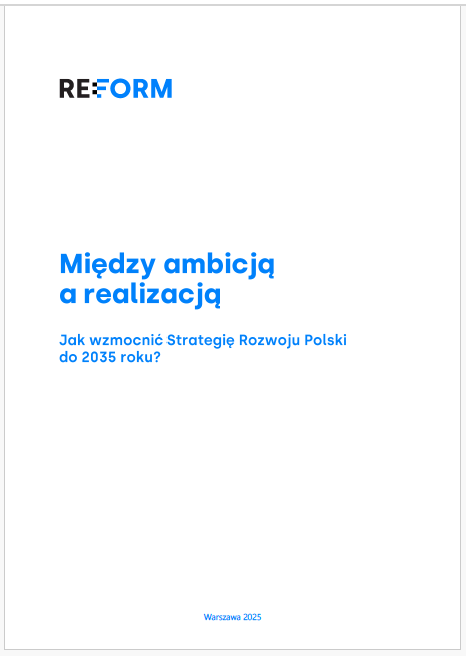
The National Development Strategy 2035 accurately identifies the challenges facing the country – social cohesion, competitiveness and security. However, it does not present a comprehensive action plan, a clear division of responsibilities between institutions, or measurable indicators and timetables. Without these elements, the document remains a collection of declarations rather than a realistic plan for Poland’s development, warns the Reform Institute in its latest study, Between ambition and implementation. How to strengthen the National Development Strategy 2035?
The National Development Strategy 2035 (NDS 2035) is one of the most important planning documents of the state – it sets out the framework for socio-economic development in the coming decade and serves as a reference point for sectoral policies and financial programmes. Therefore, its shape will directly translate into the pace of economic transformation, the standard of living of Poles and the country’s competitive position in a changing global environment.
Detachment from EU frameworks and support mechanisms
Meanwhile, the strategy is not linked to key European initiatives such as the Clean Industrial Deal or the new State Aid Framework (CISAF) nor does it comprehensively map the funds available in the coming years to support industrial transformation, innovation and digitalisation, including the Innovation Fund, Horizon Europe, LIFE and Digital Europe programmes. The lack of references to EU instruments may hinder Polish companies’ access to funds and participation in European supply chains.
No decisions for clean industry
For years, Polish industry has been struggling with a lack of systemic support for decarbonisation. The European Union does not require Poland to present a coherent plan in this area, and at the national level, the issue of industrial transformation still has no owner – it is unclear whether it is the Ministry of Development and Technology, the Ministry of Climate and Environment, or perhaps the Ministry of Energy.
National Development Strategy 2035 is the ideal document to specify the ministry responsible for industrial transformation and make a clear declaration on launching comprehensive support for Polish companies in this area. However, after reading the document, we still do not know who is responsible for managing this change, notes Aleksander Śniegocki, president of the Reform Institute.
Electrification – an overlooked driver of growth
One of the document’s biggest shortcomings is its failure to mention the electrification of the economy as an important direction for growth and strengthening the resilience of the Polish economy. For example, Poland is electrifying its industry more slowly than the EU average (26% compared to 32%), and the strategy does not indicate any measures that could accelerate this process. Meanwhile, the transition to clean electricity can ensure lower and stable energy prices and attract investment in the production of clean technologies.
Therefore, the Reform Institute recommends separating the electrification of the economy as a separate priority, including support mechanisms and infrastructure investments.
Separate goals for economic competitiveness and resilience
National Development Strategy 2035 separates the goals of economic competitiveness and national security. This approach perpetuates the silo mentality in public policy and hinders the creation of an integrated system for managing the country’s development.
The document lacks an analysis of how the development of an innovative and low-carbon economy can strengthen the systemic stability of the state. There is also no indication of how energy and raw material security affect Poland’s investment attractiveness, macroeconomic stability and development capacity.
Meanwhile, an innovative economy provides the resources necessary for the state to carry out its tasks in the areas of defense, ensuring good quality infrastructure and public services. At the same time, a secure environment (in terms of energy, raw materials, and digital technology) is a prerequisite for predictability and stability for investment and business development, according to the study.
Lack of multi-level dialogue with actors involved in the transition
The National Development Strategy 2035 does not foresee real business involvement in the process of implementing and updating objectives. There is a lack of ongoing, multi-level dialogue with stakeholders, including the business community, academia, and social organisations. This weakens the chances of effective implementation of the planned reforms and hinders the building of a lasting consensus around economic transformation.
Polish entrepreneurs are most familiar with the barriers and opportunities for development. Meanwhile, they have been relegated to the role of policy implementers, instead of being partners in shaping them. In such a situation, even well-founded ambitions may not translate into practice. This, in turn, threatens to lose the opportunity to build a lasting competitive advantage, explains Zofia Wetmańska, vice-president of the Reform Institute.
The Reform Institute calls for strengthening public-social-economic partnerships and establishing a permanent system of dialogue with stakeholders, covering the creation, monitoring and evaluation of strategy implementation. A broad partnership will also increase the strategy’s resilience to political fluctuations and ensure its institutional continuity, which is important for long-term development planning. Therefore, joint responsibility for the implementation of the strategy’s objectives should become a shared commitment of the administration, businesses, local governments, and social organisations.
The need for a different narrative around the transition
The energy transition in the National Development Strategy 2035 is presented mainly as a cost rather than an investment. Meanwhile, as the Reform Institute emphasizes, expenditure of PLN 1.8 trillion will bring long-term benefits: cheaper energy, greater independence from fossil fuel imports, and the development of modern industry.
The strategy treats the transition as a barrier and fails to recognize its positive role in making the Polish economy independent of expensive and mostly imported fossil fuels, or Poland’s role in clean industry value chains.
Changing the language around the transition could help build public acceptance for the necessary reforms.
Attempt to introduce systemic monitoring
The Reform Institute welcomes the announcement of systemic monitoring of strategy implementation through the introduction of a cyclical Annual Strategic Diagnosis.
According to the study, this solution can significantly increase the transparency of administrative activities and serve as a real tool for adjusting public policies in the face of changing economic and geopolitical conditions.
However, the Reform Institute notes that without assigning measurable indicators to strategic objectives and designating institutions responsible for specific actions, the evaluation mechanism will not be reliable or effective. As a result, there is a risk that the document will lose its operational character and become merely a policy statement rather than a practical tool for managing the country’s development.
The Reform Institute emphasizes that a refined National Development Strategy 2035 could become an important tool for the country’s development, serving to build a resilient and competitive economy.
NDS 2035 has the potential to open a new chapter in the management of Poland’s development. The prerequisite is to overcome the barriers that have been limiting the effectiveness of public policies and the state’s ability to achieve long-term development goals for years. We need to move away from silo planning, prioritise systemic solutions over ad hoc and reactive changes, and focus on maximising long-term benefits for society as a whole. Poland needs a strategy that not only diagnoses challenges but also shows the way to solve them. The document, which is to serve as a roadmap for the country’s development, must take full advantage of the opportunities arising from the inflow of EU funds to Poland and our country’s industrial potential, concludes Wetmańska.
A full report is available in Polish.
















Zapisz się
do newslettera