
The government has announced support for investment, but industry is still waiting for concrete details. The new ‘Quarterly Monitoring of Polish Industrial Transformation’

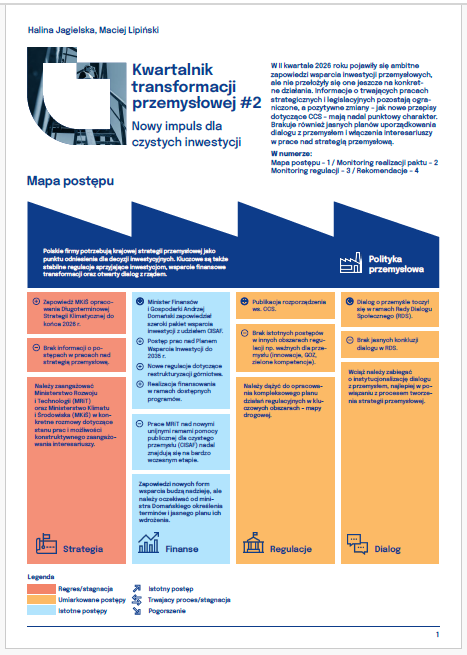
The second issue of the Quarterly Monitoring of Polish Industrial Transformation “A new impulse for clean investments” shows that the coming months of 2026 are bringing a wind of change to Polish industry. Important announcements have been made regarding new instruments to support investment, but these have yet to be translated into concrete actions, timetables and implementation mechanisms.
This new publication continues the series of quarterly reviews, launched earlier this year, tracking progress on the proposals put forward by Polish companies and industry organisations as set out in the Pact for Polish Industry. The first edition showed that, whilst other EU countries were stepping up their efforts towards a clean industry, Poland was lagging behind in implementing support measures, including mechanisms based on the EU’s CISAF state aid framework.
The second issue of the Quarterly Monitoring now presents a more nuanced picture: there have been signs of increased activity and new government announcements, but there is still a lack of tangible results for companies planning investments in decarbonisation, energy efficiency, clean technologies and production modernisation.
“Polish industry needs not only declarations, but a predictable action plan: an industrial strategy, stable regulations, funding for the transition and ongoing dialogue with the administration. Without this, companies will not be able to make investment decisions at the pace required to maintain European and global competitiveness” – says Maciej Lipiński, an analyst at the Reform Institute and author of the Quarterly Monitoring.
Ambitious financial announcements, but CISAF still at an early stage
One of the most important events of the second quarter was the announcement of a package of five economic programmes supporting investment, including, amongst others, investment grants, support for clean technologies, reform of the Polish Investment Zone, reform of KUKE (Export Credit Insurance Corporation), and the Accelerate PL programme for start-ups. The authors of the Quarterly Monitoring view this direction as a positive sign, but emphasise the need to swiftly put the announced instruments into operation.
Of particular importance is the implementation in Poland of mechanisms based on CISAF – the EU’s state aid framework for clean industry. Work on this solution at the Ministry of Development and Technology (MRiT) remains in the ‘analytical and conceptual’ phase, which makes it difficult for businesses to prepare investment projects and assess available funding routes.
The authors also draw attention to the progress of work on the Programme for the Development of Investment in the Polish Economy up to 2035, which has undergone consultations and may be adopted in the third quarter of 2026. This document is intended to set out the state’s investment priorities and replace the current programme.
Industrial strategy still lacks a breakthrough
In the area of industrial policy, the Quarterly Monitoring highlights the lack of new information on progress regarding the industrial strategy. At the same time, it welcomes the announcement by the Ministry of Climate and Environment regarding the preparation of a Long-Term Climate Strategy by the end of 2026. This strategy is to be based on four pillars: sovereignty and security, sectoral modernisation, investment and development, and social benefits.
However, according to the authors, it will be crucial to link work on the climate strategy with the process of developing the industrial strategy and with dialogue with businesses and industry organisations. Without coherence between these processes, Poland may fail to seize the opportunity to build national value chains, develop local content and attract investment in clean technologies.
An important step on CCS, but regulatory progress remains piecemeal
The most concrete regulatory progress in the second quarter was the publication of a regulation designating 18 potential sites for underground CO₂ storage. The authors regard this as an important step towards building a domestic CCUS market in Poland and creating the conditions for the decarbonisation of sectors that are difficult to electrify.
“Regulatory changes remain piecemeal. In some areas crucial to industrial transformation – such as the circular economy, green skills, innovation and labour law – no significant progress was recorded in the second quarter,” – notes Halina Jagielska, an analyst at the Reform Institute and author of the Quarterly Monitoring.
Dialogue with industry requires institutionalisation
The Quarterly notes that issues relating to just transition, the National Energy and Climate Plan, industrial policy and the situation of mining communities were discussed within the framework of the Social Dialogue Council. The authors point out, however, that this dialogue has not yet yielded any clear conclusions.
The authors of the publication recommend establishing a permanent, institutionalised form of dialogue on industry, ideally linked to the process of developing industrial strategy. Such a mechanism would enable the regular involvement of enterprises, trade associations and other stakeholders in work on the most important strategic and regulatory documents.
Spain as an example of the effective use of EU instruments
In the section on international best practices, the authors describe the Spanish model for supporting the hydrogen economy. Spain secured €1.2 billion from the EU for the development of this sector even before the implementation of the CISAF framework, and subsequently combined national funding with the ‘Auction-as-a-Service’ mechanism under the European Hydrogen Bank.
This example demonstrates that an effective industrial policy requires combining sources of funding, flexible instrument design and early market preparation for the use of new support mechanisms.
Recommendations: strategy, funding, regulation and dialogue
The authors of the second Quarterly set out a series of recommendations for the government and industry. The most important of these include: ensuring industry’s involvement in shaping industrial strategy; the swift and transparent implementation of CISAF in Poland; involving industry in work on PEP2050 and the Long-Term Climate Strategy; the implementation of the announced investment programmes; and the establishment of a permanent forum for dialogue on industry.
“Quarterly Monitoring of Polish Industrial Transformation #2: A New Impulse for Clean Investments” is available here.



PLN 200 billion from the EU ETS for Poland – a figure that goes unmentioned. Reform of the system offers an opportunity to maximise the benefits

In 2025, Polish grid operators refused to connect 107 GW of renewable energy capacity. The European Commission wants to accelerate electrification ninefold

Quarterly Monitoring of Polish Industrial Transformation 1/2026. Delayed Start in the European Race

The capacity fee is holding back the electrification of industry. The Reform Institute is proposing a reform


Zapisz się
do newslettera